Undertones
Paint undertones: reading the colour under the colour
A white wall almost never reads as white. Every off white and every beige carries a second, weaker colour under the surface colour, and that second colour decides whether a room reads warm, cold or faintly grubby.
Decorators call the weaker colour the undertone. Undertones exist because a paint mixed from titanium dioxide alone reads harsh, so manufacturers add yellow oxide, raw umber, black or a trace of blue to soften the mix. The tint additions run under 3 percent of total tint load in most near whites, which is why a 50 mm fan deck chip hides an undertone and a 4 square metre wall broadcasts the same undertone.
The strip at the top of the page holds five paints inside a 15 point LRV band. #FFFDF8 sits at LRV 98, close to raw titanium white, with almost no tint load. #F4F0E4 at LRV 87 carries yellow oxide. #EDEFE7 at LRV 86 carries a green cast from yellow oxide combined with black. #EDECF0 at LRV 84 leans blue. #F1EAE7 at LRV 83 leans pink from a red oxide trace. Viewed separately, all five paints pass as white. Butted together with no gap, the five separate into four distinct tint families plus one untinted white.
| Hex | LRV | Undertone | Tint over the titanium base | Where the undertone shows first |
|---|---|---|---|---|
| #FFFDF8 | 98 | none | under 0.5 percent | nowhere; reads as raw white in every light |
| #F4F0E4 | 87 | yellow | yellow oxide | south facing wall in direct sun at 12:00 |
| #EDEFE7 | 86 | green | yellow oxide plus black | shaded wall under 2700K lamps |
| #EDECF0 | 84 | blue | blue plus a trace of black | north facing wall at 13:00, 7500K sky light |
| #F1EAE7 | 83 | pink | red oxide | beside grey porcelain at LRV 43 |
Method one
How do you expose a paint undertone against a true white card?
A true white reference card exposes a paint undertone within two seconds at the join between the two surfaces. Matt mounting card measures roughly LRV 94 to 96 and carries almost no tint, so any yellow, green, blue or pink in the paint sample appears as a visible edge against the card.
Buy a pack of matt white A4 card, 21.0 cm by 29.7 cm, the plain kind sold for mounting drawings, and keep one sheet unused as a permanent reference. Lay the paint sample flat on the card so the two surfaces touch along one edge with no gap and no shadow line.
Read the join, not the middle of the sample. The eye resolves a boundary between two near whites far more reliably than a single field of colour, which is why a sample held two centimetres clear of the card gives no reading at all.
Both surfaces need the same angle to the light. A sample tipped towards the glass collects 7500K sky light and reads cooler than the identical paint lying flat on the card. Move both surfaces to a north facing window and away from any lamp, because a 2700K bulb adds yellow to the card and the sample at the same time and cancels the comparison.
Sheen changes the reading as much as light does. A mid sheen surface returns the light source to the eye as a specular highlight and washes the tint out, so compare matt against matt whenever the finish allows.
Method two
Why does a single paint sample give the wrong reading?
Simultaneous contrast makes a single paint sample unreadable, because the human eye reports differences between adjacent surfaces rather than absolute values. The yellow white #F4F0E4 at LRV 87 reads almost neutral beside a cream, and the same #F4F0E4 reads distinctly gold beside the blue white #EDECF0 at LRV 84.
One chip held against a magnolia hallway reports the hallway, not the chip. The reading changes again in the next room, which is how a paint chosen in a hall arrives on a bedroom wall as a different colour.
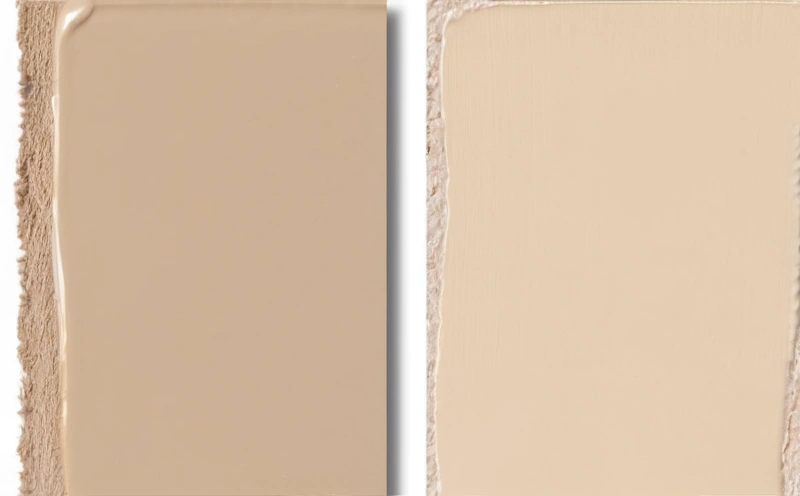
Three samples fix the problem. Place the candidate paint between two knowns, one clearly warm and one clearly cool, and the candidate falls into a family within seconds. Using the strip above, put a sample between #F4F0E4 and #EDECF0: a yellow leaning white drops towards #F4F0E4 and reads creamy, while a neutral white sits between the two without joining either.
Painters who work this way carry a board of five references: yellow, green, blue, pink and neutral. Five references cover every tint family used in domestic near whites and fit on a single sheet of A4 card at 21.0 cm by 29.7 cm.
Method three
What sample size in centimetres gives a reliable undertone judgement?
A 50 mm fan deck chip covers 25 square centimetres. An A2 sample board covers 42.0 cm by 59.4 cm, or 2,495 square centimetres, which is 100 times the chip area and the smallest size that predicts how an undertone behaves across a four square metre wall.
Paint two full coats onto A2 primed card, recoating at 4 hours at 20 C and 50 percent relative humidity, and leave a 40 mm unpainted border on all four sides so the surrounding wall cannot bleed into the judgement. Let the board cure 24 hours before reading the colour.
Wet emulsion reads darker and slightly warmer than the cured film, and a single coat over white card reads 3 to 5 LRV points lighter than the finished two coat wall. Water based matt emulsion reaches full hardness at 14 days, though the colour stops shifting well before that point.
Tape the cured board to the wall due for painting, then move the same board to a second wall in the same room. A paint that holds its family on both walls is a safe specification. A paint that turns grey on the wall opposite the window is reporting its undertone under low light, not reporting a fault in the mix.
Read every board at three fixed times: mid morning, 14:00, and after dark under the lamps the room actually uses. A 2700K bulb pushes every near white towards yellow, which rescues the cold #EDECF0 at LRV 84 and makes the cream #F4F0E4 at LRV 87 read dirty.
Beiges
Which beige undertones fail next to oak flooring and grey porcelain?
Beige is a yellow or orange grey between LRV 45 and LRV 70, and the undertone error grows as the value drops. Black added to a yellow base turns the mix green, which is why stone coloured paints read khaki on a shaded wall, and violet based greige turns pink under 2700K lamps.
The four surfaces above are the fixed materials that most often decide a beige. Limestone #E8E4DB sits at LRV 78, travertine #BFB6A6 at LRV 47, grey porcelain #A7B2AE at LRV 43 and mid oak #8A6A45 at LRV 16. Test a beige against the white card first, then against whichever of the four already exists in the room.
Oak flooring at #8A6A45 pulls orange out of a beige by simultaneous contrast and can push a neutral sample towards salmon. Grey porcelain at #A7B2AE does the reverse and leaves the identical beige reading yellow. The paint has not changed between the two tests; the neighbouring surface has.
The specification question is not which beige is best in the fan deck. The specification question is which beige holds its tint family against the floor, the worktop and the lamps in one named room.